Quanta oscurità abita nella tua luce?
How much darkness is in your light?
english articles
quesito numero dodici
Quanta luce abita nella tua oscurità?
How much light is in your darkness?
Aut – Aut (English version)
Aut – Aut
Good and evil, joy and sadness, light and darkness, yin and yang and so on: we are surrounded by dualisms and dichotomies. However these oppositions and contrasts are only the final moment of a series of actions called choices.

Simple, difficult, complex or painful: the choices characterize and determine us. But how do they affect us? Are they so necessary?
In 1843 the Danish philosopher Sören Kierkegaard wrote a work entitled “Aut – Aut”. Aut is an adverse latin conjunction and it means either. The title translation therefore corresponds to “Or this or that”.
In particular, Kierkegaard emphasizes the dramatic vacuity of an “aesthetic” life dedicated to the ephemeral pleasure of the present moment. What should we do? Should we persevere with this kind of life of nothingness or opt for an “ethical” life, morally more acceptable and directed to the future but looking back to the past?
We have a variety of options and possibilities that can be fascinating and intriguing but also highly destabilizing.
“What do you choose? You choose yourself, not in your own immediacy, not as this casual individual, but you choose yourself in the eternal value […] “. (cit. Aut-Aut, ed. Mondadori, pp. 90-92)
The act of choosing is therefore fundamental as a moment of “reconquest” one’s own self. When you choose, you choose yourself in an active way and not passively. The multiplicity of options we can come across always have to be seen as an opportunity.
Choices may be right or wrong, but they will always be a manifestation of what we are and can not ignore.
For curiosity:
“Aut-Aut” by Sören Kierkegaard, Mondadori
“Filosofia” by Sergio Moravia, 3rd volume, ed. Le Monnier
Maria Domenica Depalo
quesito numero undici
Se il tempo si fermasse all’improvviso, saremmo pronti a vivere lo stesso istante che si ripete identico a se stesso?
If the time stopped suddenly, would we be ready to live the same istant that repeats itself in an identical way?
Quesito numero dieci
Quanto il dubbio e l’incertezza possono arricchirci?
How can the doubt and the uncertainty enrich us?
Quesito numero nove
Quanto siamo determinati dal passato?
How are we determined and influenced by the past?
Quesito numero otto
Si può fare a meno del fallimento derivante dai nostri errori?
Is the failure of our mistakes really necessary?
The identity in the relationship between me and the other
The identity in the relationship between me and the other
Who am I? What is my role? What do I think about the idea that the others have about me?
The theme of the identity characterizes our daily path in an alternation of questions and uncertain answers. When we finally think we have understood who we are, a doubt brings us back to the indeterminacy of our limits.
There is no sure definition that describes us in a full and exhaustive way. This happens simply because we are “becoming beings”, subject to the multiplicity and variety of events that changes, like our body.
The mirror, in which our image is reflected, is the enormous witness of our non-fixity. The change of our face, the appearance of wrinkles and the signs of the flow of time seem to remind us constantly that we are “fluent”.
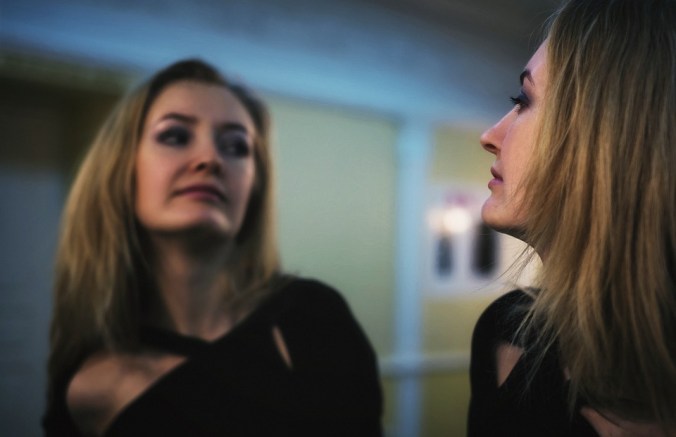
However, it is important to emphasize the positive aspect of this kind of fluidity. We could interpret it as the ability to adapt to what surrounds us.
The presence of the other influences us. The other becomes a mirror, unique and personal, capable of realizing an image of us often different from the one we attribute to ourselves. Everyone in fact develops a personal idea of the other.
So who are we? Are we in the way the others think about our person?
The philosopher Sartre doesn’t offer any definitive answer to this question: “Our human reality requires to be simultaneously for themselves and for others” (cit. From “The Essence and the Nothing”) showing the drama of this unsolvable dichotomy.
We persist in a state of doubt on our personal identity without apparent possibility of solution. Perhaps, however, the insolubility of this dilemma could be our salvation to a staticity that could take to annihilation.
For curiosity, I would recommend:
“L’essere e il Nulla” of Jean – Paul Sartre
“Uno, Nessuno e Centomila” of Luigi Pirandello
https://freewordsmagazine.wordpress.com/2017/06/28/luigi-pirandello-il-figlio-del-caos/
Maria Domenica Depalo
What is philosophy?
What is philosophy?
Wikipedia defines it as a “field of study that questions and reflects upon the world and on the human being, investigates the sense of being and human existence, tries to define nature and analyzes the possibilities and the limits of knowledge”. (from https://it.wikipedia.org/wiki/Filosophia)
The definition seems ok. However, we will try to overcome this wikipedian presentation to try to show its further and more subtle aspects. The purpose of this site is in fact to awaken questions that lie in each of us and are ready to be asked.
However, to avoid misunderstandings, it should be clear that there is no guarantee that there will be certain and satisfactory answers. In fact, often and willingly, the answers will be additional questions ready to stimulate our curiosity and desire to investigate going beyond the visible and known.
Symbol of our path will be the owl of Minerva, the goddess born of the head of Jupiter. Goddess of justice and wisdom, Minerva is the Roman version of Athena, the goddess who accompanied Ulysses, the symbol of excellence in the ratio and knowledge.
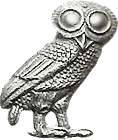
Di –SGOvD webmaster (talk) 19:11, 24 July 2006 (UTC) – File:Owl of Minerva.png, CC BY-SA 3.0, https://commons.wikimedia.org/w/index.php?curid=7228724
Everyone will have the opportunity to ask questions and express opinions and ideas.
In fact, the articles will be accompanied by an English version in order to help everyone to understand. I would conclude with an invitation to visit the sections that, I hope, will soon be enriched by articles and reflections.
Good philosophy!
Maria Domenica Depalo

