Hymn to the woman

Hymn to the woman

Against the screams of those who get excited for a male striptease believing that this is women emancipation, against those who believe that femininity consists in dominating me, here are the words of a great observer, Alda Merini, that gently but also with decision shows the beauty of being a woman.

A woman is a queen of the creatures, holder of dreams, fortune, forgiveness and grace. A woman is a creature but also a creator, a life and a sap that nourishes and gives often without receiving anything in return. A woman is a storm but also the calm on the horizon.

A woman is.

Hymn to the woman

Wonderful
immaculate luck
for you all creatures
of the kingdom
are open
and you became the queen
of our shadows
for you men
took
countless flights
created the beehive of the
thought
for you woman has arisen
the murmur of the water
only grace
and tremble for yours
incantations
that are in your hands
and you have a dream
for every summer
a child for every cry
a suspicion of love
for each hair
now you are a woman
all a forgiveness
and as you live in it
the divine thought
it will flourish in secret
surrounded
from your grace.

Alda Merini

You surround me completely

You surround me completely

Dear philosophers, today we talk about love and we do it through its myth in the “Symposium” written by Plato and the latest film directed by Guillermo del Toro, “the shape of water”.

Extraordinarily beautiful, romantic and visionary, this film is the delicate narration of a love that goes beyond limits, differences and obstacles. It is the story of two solitudes that are saved by their first meeting but actually it is a return of two souls in an ancient place, their unique heart.

The Greek myth states that at the beginning of time there were no men and women but perfect creatures bound together by their shoulders: men and women together, united forever in body and soul. Zeus, fearing their growing power, separated these beings that, since that day, continue to seek each other trying to come together to form their lost unity.

“Then, as I said, we were one person, but now, for our fault, the god has separated us into two persons […] That’s why we must always exhort men to respect the gods: not just to escape this ‘last evil, but also to get the joys of love that Eros, our guide and leader, promises us. No one resists him – because whoever resists love is unpopular to the gods. If we become friends with this god, if we will be in peace with him, then we will be able to meet and discover our half soul, which now happens to very few “. cit. di Plato, The Symposium (complete text in http://www.ilgiardinodeipensieri.eu/testi/simposio.html)

The deep difference between Elsa and the creature reminds me this myth.

Set in the America of the cold but threatening conflict with Russia, the film tells the  intense story of a simple and lonely woman and a mysterious creature.

Destined to certain death, the “monster” awakens Elisa, bringing her to face unimaginable dangers and obstacles so distant from her anonymous life.

The gloomy scenario becomes alive with a representation full of details and colours, showing us the strenght of a love that goes beyond everything.

Dream and reality, magic and concreteness blend harmoniously giving life to a show that nourishes the soul of the observer. The two solitudes seem to reconstitute that ancient lost, so rare and precious unity.

I suggest the vision of this film, inviting you to reflect on the power of love that makes strong what is fragile, a unity what is divided.

“Unable to perceive your form, I find you all around me. Your presence fills me with the eyes of your love, my heart becomes small because you are everywhere”. (from the film)

Do you believe in love? Do you also believe that it can change destiny?

https://www.youtube.com/watch?v=XFYWazblaUA

Maria Domenica Depalo

Identity and singolarity

Identity and singolarity

I am me and you are you. Apparently it is a simple statement. In reality it is not  because that I” could become a “you” and that “you” could become an “I”. It seems a linguistic game. We are talking instead about genetics and the possible ethical and moral implications of one of the most extraordinary and incredible discoveries of these recent years: cloning. But let’s try to understand something.

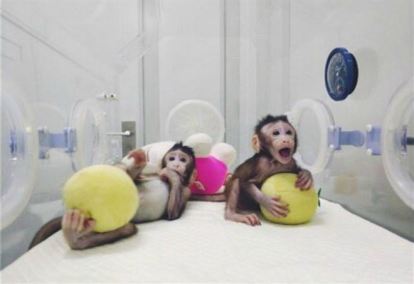
Zhong Zhong and Hua Hua were born some weeks ago. We are talking about two nice and funny monkeys. However, they are not twins but clones obtained in a Chinese laboratory through methods that provide for the “duplication of the genetic heritage of a single cell or an entire organism” (see below).

liberescelte-it

Ecco le scimmiette Zhong Zhong e Hua Hua intente a giocare allegramente. fonte dell’immagine: liberescelte.it

The scientists assert that cloning non-human primates could actively contribute to the research of numerous neurodegenerative diseases and therefore also to the discovery of ad hoc therapies.

The advantages therefore would be numerous but we have to consider the risk of the loss of the individual identity, of what distinguishes and characterizes us.

Each of us is different, our singularity is our personal mark. But what could happen if somebody decided that someone’s uniqueness is worth more than someone else’s? What about human diversity and variety? What would happen to what “does not fit”? It seems like a distant scenario but the risk subsists and we shouldn’t underestimated it.

Personally I think that every discovery for the wellness and health of everyone is a blessing. However, we must think about  the possible implications and possible dangers.

What do you think about cloning and the risk to lose the personal identity? Share, if you want, your thoughts with me and the other readers and philosophers.

Thank you so much and enjoy reading!

On freewords you will find an interesting article about this argument written by my colleague and friend Enza Bronzuoli.

Other links:

http://www.filosofico.net/bioeticaclonaz.htm

https://freewordsmagazine.wordpress.com/2018/01/31/clonate-due-scimmie/ 

Maria Domenica Depalo


Chocolate Ode

Chocolate Ode

Perfumed, delicate but also strong in its flavour, unique in the variety of colours and shapes, chocolate is the essence of pleasure to be enjoyed slowly.

Smooth on the surface, without imperfections or ripples but with the scent of cocoa, it should not be bitten greedily but slowly dissolved in the mouth in order to catch its fragrances, flavours and aromas. Every aspect of chocolate must be captured in its entirety.

The chocolate ritual must be consummated according to times and methods that are personal and particular. Once a day or two or three: it doesn’t matter. What matters is to know how to lose oneself in a dimension that takes us far from our reality, even if for a few moments, but which seems infinite.

Therefore we entrust our passion to the words of the extraordinary poet Alda Merini who highlights its link with love, friendship and deeper emotions.

“The sweetness of the heart
comes from sweet drinks
black as night,
white like paradise.
On these chocolate baste verses or speak light.
This is the friendship born at the table
when you smile at me like chocolate “.

~ Alda Merini

Link:

https://festedelcioccolato.it/

https://freewordsmagazine.wordpress.com/2018/02/05/cioccolato-mon-amour/

Questo slideshow richiede JavaScript.

Maria Domenica Depalo

What makes us happy?

What makes us happy?

Each of us aspires to happiness but if we had to define it in a unique and valid way for everyone, could we really consider us sufficiently satisfied by the definitions we find in the dictionaries?

Wikipedia defines happiness as “the positive mood of those who consider all their desires satisfied” (taken fromhttps://it.m.wikipedia.org/wiki/Felicit%C3%A0).

The Treccani Encyclopedia, showing its meaning, attributes it to those who “are not troubled by pain or worry and enjoy this state” (from www.treccani.it/enciclopedia/felicita).

Garzanti states how happiness is the “state of those who are happy, those who feel satisfied with every desire, joy, complete satisfaction …” (taken from https://www.garzantilinguistica.it/ricerca/?q=felicit% C3% A0).

These definitions can actually give us an idea of ​​what happiness is and about its characteristics. But what makes us happy giving colour and flavor to our days?

After my father’s suggestion I read a very interesting article written by Concita de Gregorio, whose title is “List of little things that make me happy”. It gave me the possibility to reflect on what makes happy. Often little things give us happiness taking us  far from our darkness and sadness.

I would therefore like to propose to each of you to write your personal list of “little things that make you happy” and to comment on it together. You could tell about your dreams, about big and small desires, about what is able to awaken and keep our little personal spring oasis alive.

The list can be as long as you want. I would start with my own (written not in order of importance).

Good happiness!

Makes me happy:

  1. walk around feeling the scent of the sea
  2. speak in German
  3. prepare sweets
  4. stay with the people I love
  5. snoop
  6. to dream
  7. to sleep
  8. to watch “Montalbano”
  9. to travel
  10. learn

Maria Domenica Depalo

Don’t insist

Do not insist

Dear philosophers,

I’d like to share with you the verses of Ada Luz Marquez, a talented contemporary Spanish poet, a lover of nature and a blogger. I have chosen these deep and beautiful verses because they are an invitation to patience.

We wait love but love is a flower that waits to blossom in us and outside us. It has its own times that vary from person to person. However, often we don’t remember this and impatient we turn around the flower hoping that it blooms earlier but sometimes we must only wait and embrace our personal winter waiting for spring.

What do you think about the waitings?

“Don’t insist
the flower doesn’t bloom
before the right time.
Not even if you beg for it
even if you try to open its petals
even if you flood it with sunshine.
Your impatience
pushes you to look for spring
when you just need to
embrace your winter. “
Ada Luz Márquez

Maria Domenica Depalo


The return

The return

Here we are with our reflections after a some time. So let’s start again with K. Gibran, a very deep poet and thinker of Lebanese origins but American citizen. We will focus our attention on the ineffability of time and on the eternity whose custodians we are even in our finitude.

Eternity consists of past, present and future but what are they? The present moment is the memory of yesterday because although it is currently present, it can turn to the past and the past represents our roots.

Tomorrow is described as the dream of today because when we think of the future we plan and dream.

“The eternal that is in us, knows that life is timeless and knows that today is only the memory of yesterday and tomorrow the dream of today”.

l'eterno

foto di ©MariaDomenicaDepalo

Maria Domenica Depalo

Quesito numero cinquantaquattro

Quesito numero cinquantaquattro

Amiche ed amici della filosofia,

Thomas Hobbes è un filosofo inglese, autore di “The Leviatan”. Nel suo saggio egli descrive la società umana che gli appare permeata da un profondo senso di lotta fratricida. D’altro canto sua è l’espressione “Homo homini lupus” secondo la quale gli uomini si comporterebbero da lupi gli uni con gli altri.

Le motivazioni di questa lotta possono essere molteplici: amore, denaro o desiderio di potere.

Appare pertanto straordinario il messaggio del piccolo Auggie, protagonista del film “Wonder”, con Julia Roberts e Owen Wilson, afflitto da una deformazione al viso.

In un mondo dominato dalla rabbia, egli parla di gentilezza: “Quando puoi scegliere tra l’essere giusto e gentile, scegli di essere gentile”.

Dov’è la nostra gentilezza? Siamo solo lupi?

Maria Domenica Depalo

You find the English version on the following page–>

Kiss the rain

Kiss the rain

Care amiche ed amici della filosofia,

in Puglia piove ed il cielo appare grigio. Con il suo movimento rassicurante e silenzioso, la pioggia sembra scandire in modo diverso ma pur sempre costante il passare delle ore.  Il sole è nascosto dalle nuvole e la giornata sembrerebbe scorrere in modo uggioso e cupo ma spetta solo a noi decidere quale impronta e corso darle.

Le gocce trasparenti si nutrono dei colori che vogliamo dar loro. Scure, chiare o persino colorate, attraverso loro leggiamo il nostro stato d’animo e vediamo in modo più evidente che mai chi siamo.

Appena ho percepito le prime gocce, ho ricordato il testo di una canzone ed ho pensato che mi sarebbe piaciuto condividerla con voi. Sarà quindi uno dei “luoghi del pensiero” di questo mese. Si tratta di “Kiss the rain” del 1997 della cantautrice inglese “Billie Myers”.

Quale rapporto avete con la pioggia? Cosa esprimono le sue acque?

English version

Dear philosophers,

in Puglia it rains and the sky appears grey. With its silent movement, the rain seems to mark the passing of the hours in a different but constant way. The sun is hidden by the clouds and the day seems flowing boring and sad, but only we have the power and ability to decide which imprint and course our day should have.

The transparent drops are fed by the colors we want to give them. Dark, clear or even coloured, through them we read our state of mind and see more clearly than ever who we are.

As soon as I perceived the first drops, I remembered the lyrics of a song and I thought it should have been nice if I have shared it with you.

This is “Kiss the rain” from 1997 of the English singer “Billie Myers”. This song will be one of “places of thought” of this mounth.

What relationship have you with the rain? What do its waters express?

Kiss the rain

Hello
Can you hear me?
Am I gettin’ through to you?
Hello
Is it late there?
There’s a laughter on the line
Are you sure you’re there alone?
Cause I’m
Tryin’ to explain
Somethin’s wrong
Ya just don’t sound the same
Why don’t you
Why don’t you
Go outside
Go outside
Kiss the rain
Whenever you need me
Kiss the rain
Whenever I’m gone, too long.
If your lips
Feel lonely and thirsty
Kiss the rain
And wait for the dawn.
Keep in mind
We’re under the same sky
And the nights
As empty for me, as for you
If ya feel
You can’t wait till mornin’
Kiss the rain
Kiss the rain
Kiss the rain
Hello
Do you miss me?
I hear you say you do
But not the way I’m missin’ you
What’s new?
How’s the weather?
Is it stormy where you are?
Cause you sound so close but it feels like you’re so far
Oh would it mean anything
If you knew
What I’m left imagining
In my mind
In my mind
Would you go
Would you go
Kiss the rain
And you’d fall over me
Think of me
Think of me
Think of me
Only me
Kiss the rain
Whenever you need me
Kiss the rain
Whenever I’m gone too long
If your lips
Feel hungry and tempted
Kiss the rain
and wait for the dawn
Keep in mind
We’re under the same skies
And the nights
As empty for me, as for you
If you feel
You can’t wait till morning
Kiss the rain
Kiss the rain
Kiss the rain
Kiss the rain
Kiss the rain
Oooooohhhhh
Kiss the rain
Oooooohhhhh
Kiss the rain
Hello
Can ya hear me?
Can ya hear me?
Can ya hear me?

(da https://www.canzoni.it/testi/billie-myers/kiss-the-rain.html )

Il video della canzone è qui:

https://www.youtube.com/watch?v=Kq-r4ZUpels

Maria Domenica Depalo


Quesito numero cinquantatre

Quesito numero cinquantatre

Saldi, sconti, prezzi più bassi: soldi da spendere e spandere. Pantaloni, vestiti, scarpe, trucchi: eccessi che strabordano e sembrano non avere limiti.

Il superfluo sembra diventare necessario e fondamentale persino al nostro “Io”. Non possiamo quasi farne a meno. Persino nei nostri atteggiamenti e modi di fare talvolta cerchiamo l’eccesso e lo vogliamo mostrare anche a costo di sminuire o modificare la nostra persona.

A tal proposito Bruce Lee, che non era solo un esperto di arti marziali e attore, ma anche un filosofo parlava persino di un’“infermità di un eccesso di autocoscienza” che si manifesta in alcuni “desideri”:

“[…] il desiderio di vittoria; il desiderio di ricorrere ad astuzie tecniche; il desiderio di esibire tutto ciò che si impara; il desiderio di incutere soggezione all’avversario; il desiderio di abbandonarsi ad un ruolo passivo; il desiderio di liberarsi di qualunque infermità da cui si sia eventualmente affetti”.

Quanti e quali sono i nostri eccessi?

Riferimento:

https://le-citazioni.it/parole-chiave/eccesso/

Maria Domenica Depalo

English version

Discounts and lower prices: money to spend and spread. Everything seems cheaper in this period of the year. Pants, clothes, shoes, make – up: the excesses overflow and you have the sensation that they don’t want to have limits.
The superfluous seems to become necessary and fundamental even to our “I”. We change our personality, attitudes and behaviour in order to show the excesses.
Bruce Lee, who was not only an expert in martial arts and actor, but also a philosopher, spoke about an “infirmity of an excess of self-awareness” that manifests itself in some “desires”: “[…] the desire to win; the desire to use technical tricks; the desire to exhibit everything you learn; the desire to instill subjection to the opponent; the desire to surrender to a passive role; the desire to be free from infirmities you may be suffering”.
How many and what are our excesses?
Reference:
Maria Domenica Depalo