Hymn to the woman

Hymn to the woman

Against the screams of those who get excited for a male striptease believing that this is women emancipation, against those who believe that femininity consists in dominating me, here are the words of a great observer, Alda Merini, that gently but also with decision shows the beauty of being a woman.

A woman is a queen of the creatures, holder of dreams, fortune, forgiveness and grace. A woman is a creature but also a creator, a life and a sap that nourishes and gives often without receiving anything in return. A woman is a storm but also the calm on the horizon.

A woman is.

Hymn to the woman

Wonderful
immaculate luck
for you all creatures
of the kingdom
are open
and you became the queen
of our shadows
for you men
took
countless flights
created the beehive of the
thought
for you woman has arisen
the murmur of the water
only grace
and tremble for yours
incantations
that are in your hands
and you have a dream
for every summer
a child for every cry
a suspicion of love
for each hair
now you are a woman
all a forgiveness
and as you live in it
the divine thought
it will flourish in secret
surrounded
from your grace.

Alda Merini

Ti ritrovo tutto intorno a me   

Ti ritrovo tutto intorno a me 

Cari amici filosofi, oggi parliamo d’amore e lo facciamo attraverso il mito dell’amore raccontato nel “Simposio” di Platone e l’ultimo film del regista messicano Guillermo del Toro, “la forma dell’acqua”.

Straordinariamente bello, romantico e visionario, questo film è la narrazione delicata di un amore che va oltre limiti, differenze ed ostacoli. È la storia di due solitudini che si incontrano e si salvano. Forse però non è un primo incontro ma un ritrovarsi vero e proprio.

Il mito greco afferma come all’inizio dei tempi non ci fossero uomini e donne ma creature perfette legate insieme per le spalle: uomini e donne insieme, uniti per sempre nel corpo e nell’anima. Zeus, temendo il loro crescente potere, separò questi esseri che da quel giorno continuano a cercarsi tentando di riunirsi per formare la propria unità perduta.

“Allora, come ho detto, eravamo una persona sola; ma adesso, per la nostra colpa, il dio ci ha separati in due persone […]  Ecco perché dobbiamo sempre esortare gli uomini al rispetto degli dei: non solo per fuggire quest’ultimo male, ma anche per ottenere le gioie dell’amore che ci promette Eros, nostra guida e nostro capo. A lui nessuno resista – perché chi resiste all’amore è inviso agli dei. Se diverremo amici di questo dio, se saremo in pace con lui, allora riusciremo a incontrare e a scoprire l’anima nostra metà, cosa che adesso capita a ben pochi”. cit. di Platone, Il Simposio (testo completo in  http://www.ilgiardinodeipensieri.eu/testi/simposio.html )

Il film mi ha riportato in mente questo mito proprio grazie alla profonda differenza dei protagonisti.

Ambientato nell’America del conflitto freddo ma minaccioso con la Russia, il film narra infatti la storia struggente ed intensa di una donna semplice e sola e di una creatura misteriosa.

Destinato a morte certa, il “mostro” risveglia la parte più sopita della protagonista portandola ad affrontare pericoli ed ostacoli inimmaginabili prima per la sua vita anonima.

Lo scenario cupo e a tratti inquietante  si anima di una rappresentazione ricca di particolari e colori, nonché di significati che vanno al di là di ciò che appare.

Sogno e realtà, magia e concretezza si mescolano armoniosamente dando vita ad uno spettacolo che nutre l’animo di chi l’osserva. Le due solitudini sembrano ricostituire quell’antica unità perduta e, proprio per questo motivo, così rara e preziosa.

Consiglio fortemente la visione di questo film, invitandovi ad una riflessione sulla potenza dell’amore che rende forte ciò che è fragile, unico ciò che è diviso.

“Incapace di percepire la tua forma, ti trovo tutto intorno a me, la tua presenza mi riempie degli occhi del tuo amore, il mio cuore diventa piccolo perché tu sei dappertutto”. (cit. tratta dal film)

Credete nell’amore? Credete anche voi che possa cambiare il destino?

Maria Domenica Depalo


You surround me completely

You surround me completely

Dear philosophers, today we talk about love and we do it through its myth in the “Symposium” written by Plato and the latest film directed by Guillermo del Toro, “the shape of water”.

Extraordinarily beautiful, romantic and visionary, this film is the delicate narration of a love that goes beyond limits, differences and obstacles. It is the story of two solitudes that are saved by their first meeting but actually it is a return of two souls in an ancient place, their unique heart.

The Greek myth states that at the beginning of time there were no men and women but perfect creatures bound together by their shoulders: men and women together, united forever in body and soul. Zeus, fearing their growing power, separated these beings that, since that day, continue to seek each other trying to come together to form their lost unity.

“Then, as I said, we were one person, but now, for our fault, the god has separated us into two persons […] That’s why we must always exhort men to respect the gods: not just to escape this ‘last evil, but also to get the joys of love that Eros, our guide and leader, promises us. No one resists him – because whoever resists love is unpopular to the gods. If we become friends with this god, if we will be in peace with him, then we will be able to meet and discover our half soul, which now happens to very few “. cit. di Plato, The Symposium (complete text in http://www.ilgiardinodeipensieri.eu/testi/simposio.html)

The deep difference between Elsa and the creature reminds me this myth.

Set in the America of the cold but threatening conflict with Russia, the film tells the  intense story of a simple and lonely woman and a mysterious creature.

Destined to certain death, the “monster” awakens Elisa, bringing her to face unimaginable dangers and obstacles so distant from her anonymous life.

The gloomy scenario becomes alive with a representation full of details and colours, showing us the strenght of a love that goes beyond everything.

Dream and reality, magic and concreteness blend harmoniously giving life to a show that nourishes the soul of the observer. The two solitudes seem to reconstitute that ancient lost, so rare and precious unity.

I suggest the vision of this film, inviting you to reflect on the power of love that makes strong what is fragile, a unity what is divided.

“Unable to perceive your form, I find you all around me. Your presence fills me with the eyes of your love, my heart becomes small because you are everywhere”. (from the film)

Do you believe in love? Do you also believe that it can change destiny?

https://www.youtube.com/watch?v=XFYWazblaUA

Maria Domenica Depalo
Identità e singolarità

Identità e singolarità

Io sono io e tu sei tu. Apparentemente è un’affermazione semplice. In realtà non lo è anche perché quell’io potrebbe diventare un tu e quel tu potrebbe divenire un io. Sembra un gioco linguistico invece parliamo di genetica e delle possibili implicazioni etiche e morali di una delle scoperte più straordinarie ed incredibili degli ultimi anni: la clonazione. Ma cerchiamo di capirci qualcosa.

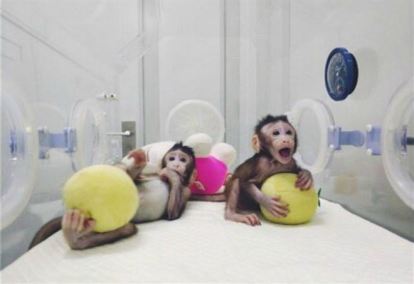
Qualche tempo fa è apparsa la notizia della nascita di Zhong Zhong e Hua Hua. Si tratta di due scimmie identiche in tutto e per tutto a partire dal loro DNA. Vispe e in buona salute, tuttavia non sono gemelle ma cloni ottenuti in laboratorio attraverso metodiche che prevedono la “duplicazione del patrimonio genetico di una singola cellula o di un intero organismo” (cit. vedi giù)

liberescelte-it

Ecco le scimmiette Zhong Zhong e Hua Hua intente a giocare allegramente. fonte dell’immagine: liberescelte.it

Gli scienziati asseriscono come la clonazione di primati non umani possa contribuire attivamente nelle ricerche su numerose patologie neurodegenerative  e quindi anche nella somministrazione di  terapie ad hoc.

Ma come non tenere conto del rischio della perdita dell’identità individuale, di ciò che ci distingue e caratterizza.

Ognuno di noi è diverso, la nostra singolarità è la nostra cifra distintiva. Ma cosa accadrebbe se per qualcuno la singolarità di una persona valesse più di quella di un’altra e si decidesse di riprodurla in serie in laboratorio? Che ne sarebbe della diversità e della varietà umane? Che ne sarebbe di quello che “non va bene”? Sembra uno scenario lontano ma il rischio sussiste e non va sottovalutato.

Personalmente ritengo che tutto quello che viene scoperto e messo in atto per il benessere di tutti sia da leggere in maniera positiva e propositiva. Tuttavia non ci può esimere dalla necessità di porre maggiore attenzione alle possibili implicazioni ed agli eventuali pericoli.

Voi cosa pensate della clonazione ma soprattutto del rischio di perdere la peculiarità dell’io? Condividete, se volete, il vostro pensiero con me e gli altri.

Grazie mille e buona lettura!

In basso trovate anche il link di freewords che vi conduce all’articolo della mia bravissima amica e collega Enza Bronzuoli.

Link:

http://www.filosofico.net/bioeticaclonaz.htm

https://freewordsmagazine.wordpress.com/2018/01/31/clonate-due-scimmie/

Maria Domenica Depalo


Identity and singolarity

Identity and singolarity

I am me and you are you. Apparently it is a simple statement. In reality it is not  because that I” could become a “you” and that “you” could become an “I”. It seems a linguistic game. We are talking instead about genetics and the possible ethical and moral implications of one of the most extraordinary and incredible discoveries of these recent years: cloning. But let’s try to understand something.

Zhong Zhong and Hua Hua were born some weeks ago. We are talking about two nice and funny monkeys. However, they are not twins but clones obtained in a Chinese laboratory through methods that provide for the “duplication of the genetic heritage of a single cell or an entire organism” (see below).

liberescelte-it

Ecco le scimmiette Zhong Zhong e Hua Hua intente a giocare allegramente. fonte dell’immagine: liberescelte.it

The scientists assert that cloning non-human primates could actively contribute to the research of numerous neurodegenerative diseases and therefore also to the discovery of ad hoc therapies.

The advantages therefore would be numerous but we have to consider the risk of the loss of the individual identity, of what distinguishes and characterizes us.

Each of us is different, our singularity is our personal mark. But what could happen if somebody decided that someone’s uniqueness is worth more than someone else’s? What about human diversity and variety? What would happen to what “does not fit”? It seems like a distant scenario but the risk subsists and we shouldn’t underestimated it.

Personally I think that every discovery for the wellness and health of everyone is a blessing. However, we must think about  the possible implications and possible dangers.

What do you think about cloning and the risk to lose the personal identity? Share, if you want, your thoughts with me and the other readers and philosophers.

Thank you so much and enjoy reading!

On freewords you will find an interesting article about this argument written by my colleague and friend Enza Bronzuoli.

Other links:

http://www.filosofico.net/bioeticaclonaz.htm

https://freewordsmagazine.wordpress.com/2018/01/31/clonate-due-scimmie/ 

Maria Domenica Depalo


Ode al cioccolato

Ode al cioccolato

Profumato, delicato ma anche deciso nel suo sapore, unico nella varietà dei colori e forme, il cioccolato rappresenta l’essenza stessa del piacere da gustare pian piano.

Liscio in superficie, senza imperfezioni o increspature, inebriante del profumo di cacao, esso non va morso avidamente ma sciolto lentamente in bocca in modo da coglierne fragranze, sapori ed aromi. Ogni suo aspetto va colto in tutta la sua totalità.

Il rito del cioccolato va consumato secondo tempi e modalità che sono personali e particolari. Una volta al dì oppure due o tre: non importa. Ciò che conta è sapersi perdere in una dimensione che ci porti lontano dalla nostra realtà, se pur per qualche istante finito che però sembra infinito.

Affidiamo pertanto la nostra passione alle parole della straordinaria poetessa Alda Merini che ne evidenzia il legame con l’amore, l’amicizia e le emozioni più profonde.

“La dolcezza del cuore
viene da dolci bevande
nere come la notte,
bianche come il paradiso.
Su queste cioccolate si imbastiscono versi o parlate leggere.
E’ questa l’amicizia che nasce a tavolino
quando tu mi sorridi come la cioccolata”.

~ Alda Merini

Link:

https://freewordsmagazine.wordpress.com/2018/02/05/cioccolato-mon-amour/

https://festedelcioccolato.it/

Seguono alcune immagini della festa del cioccolato nella sua tappa barese:

Questo slideshow richiede JavaScript.

Maria Domenica Depalo

Chocolate Ode

Chocolate Ode

Perfumed, delicate but also strong in its flavour, unique in the variety of colours and shapes, chocolate is the essence of pleasure to be enjoyed slowly.

Smooth on the surface, without imperfections or ripples but with the scent of cocoa, it should not be bitten greedily but slowly dissolved in the mouth in order to catch its fragrances, flavours and aromas. Every aspect of chocolate must be captured in its entirety.

The chocolate ritual must be consummated according to times and methods that are personal and particular. Once a day or two or three: it doesn’t matter. What matters is to know how to lose oneself in a dimension that takes us far from our reality, even if for a few moments, but which seems infinite.

Therefore we entrust our passion to the words of the extraordinary poet Alda Merini who highlights its link with love, friendship and deeper emotions.

“The sweetness of the heart
comes from sweet drinks
black as night,
white like paradise.
On these chocolate baste verses or speak light.
This is the friendship born at the table
when you smile at me like chocolate “.

~ Alda Merini

Link:

https://festedelcioccolato.it/

https://freewordsmagazine.wordpress.com/2018/02/05/cioccolato-mon-amour/

Questo slideshow richiede JavaScript.

Maria Domenica Depalo

Cosa ci rende felici?

Cosa ci rende felici?

Ognuno di noi aspira alla felicità ma se dovessimo definirla in maniera unica e valida per tutti, potremmo davvero considerarci soddisfatti della definizione che ritroviamo nei dizionari?

Wikipedia definisce la felicità come “lo stato d’animo positivo di chi ritiene soddisfatti tutti i propri desideri” (tratto da https://it.m.wikipedia.org>wiki>Felicità).

L’Enciclopedia Treccani mostrandone il significato la attribuisce a chi “non [è] turbato da dolori o preoccupazioni e gode di questo stato” (da www.treccani.it/enciclopedia/felicita).

La Garzanti afferma come la felicità sia lo “stato di chi è felice, di chi ritiene soddisfatto ogni suo desiderio; gioia, soddisfazione completa…(tratto da https://www.garzantilinguistica.it/ricerca/?q=felicit%C3%A0).

Queste definizioni in effetti possono rendere l’idea su ciò che la felicità sia e su quali possano essere alcune caratteristiche. Tuttavia è lecito chiedersi cosa in particolare ci rende felici, dando colore e sapore alle nostre giornate.

Ho avuto modo di leggere, su suggerimento di mio padre,  un articolo davvero interessante di Concita de Gregorio il cui titolo è “Elenco di piccole cose che mi rendono felice”. Mi ha dato modo di riflettere su cosa ci rende felici. Spesso si tratta di piccole cose che diamo per scontato o di cui ci siamo dimenticati presi dalle nostre oscurità e tristezze.

Vorrei pertanto proporre ad ognuno di voi di scrivere il vostro personale elenco di “piccole cose che vi rendono felici” e di commentarlo insieme. Potreste raccontare dei vostri sogni, dei desideri grandi e piccoli, di ciò che è in grado di risvegliare e tenere viva la nostra piccola oasi di primavera personale.

L’elenco può essere lungo quanto volete. Inizierei con il mio, scritto di getto, e non in ordine di importanza.

Buona felicità!

Mi rende felice:

  1. passeggiare sentendo il profumo del mare
  2. parlare in tedesco
  3. preparare dolci
  4. stare con le persone che amo
  5. curiosare
  6. sognare
  7. dormire
  8. guardare “Montalbano”
  9. viaggiare
  10. imparare.

Maria Domenica Depalo


What makes us happy?

What makes us happy?

Each of us aspires to happiness but if we had to define it in a unique and valid way for everyone, could we really consider us sufficiently satisfied by the definitions we find in the dictionaries?

Wikipedia defines happiness as “the positive mood of those who consider all their desires satisfied” (taken fromhttps://it.m.wikipedia.org/wiki/Felicit%C3%A0).

The Treccani Encyclopedia, showing its meaning, attributes it to those who “are not troubled by pain or worry and enjoy this state” (from www.treccani.it/enciclopedia/felicita).

Garzanti states how happiness is the “state of those who are happy, those who feel satisfied with every desire, joy, complete satisfaction …” (taken from https://www.garzantilinguistica.it/ricerca/?q=felicit% C3% A0).

These definitions can actually give us an idea of ​​what happiness is and about its characteristics. But what makes us happy giving colour and flavor to our days?

After my father’s suggestion I read a very interesting article written by Concita de Gregorio, whose title is “List of little things that make me happy”. It gave me the possibility to reflect on what makes happy. Often little things give us happiness taking us  far from our darkness and sadness.

I would therefore like to propose to each of you to write your personal list of “little things that make you happy” and to comment on it together. You could tell about your dreams, about big and small desires, about what is able to awaken and keep our little personal spring oasis alive.

The list can be as long as you want. I would start with my own (written not in order of importance).

Good happiness!

Makes me happy:

  1. walk around feeling the scent of the sea
  2. speak in German
  3. prepare sweets
  4. stay with the people I love
  5. snoop
  6. to dream
  7. to sleep
  8. to watch “Montalbano”
  9. to travel
  10. learn

Maria Domenica Depalo

Quesito numero cinquantacinque

Quesito numero cinquantacinque 

Care amiche ed amici della filosofia,

ho pensato di rendervi partecipi dei versi di Ada Luz Marquez,  talentuosa poetessa spagnola contemporanea, amante della natura nonché blogger. Ho scelto questi versi profondi e bellissimi perché sono un invito alla pazienza e all’attesa del bello.

Il bello è l’amore e questo è un  fiore che attende solo di sbocciare in noi e fuori di noi. Ha i suoi tempi che variano da persona a persona. Tuttavia non sempre ce ne ricordiamo ed impazienti gli giriamo intorno sperando che sbocci prima ma non serve. Dobbiamo solo attendere ed abbracciare il nostro personale inverno in attesa della primavera.

Cosa pensate delle attese?

“Non insistere
il fiore non sboccia
prima del giusto tempo.
Neanche se lo implori
neanche se provi ad aprire i suoi petali
neanche se lo inondi di sole.
La tua impazienza 
ti spinge a cercare la primavera
quando avresti solo bisogno di
abbracciare il tuo inverno.”
Ada Luz Márquez

Maria Domenica Depalo